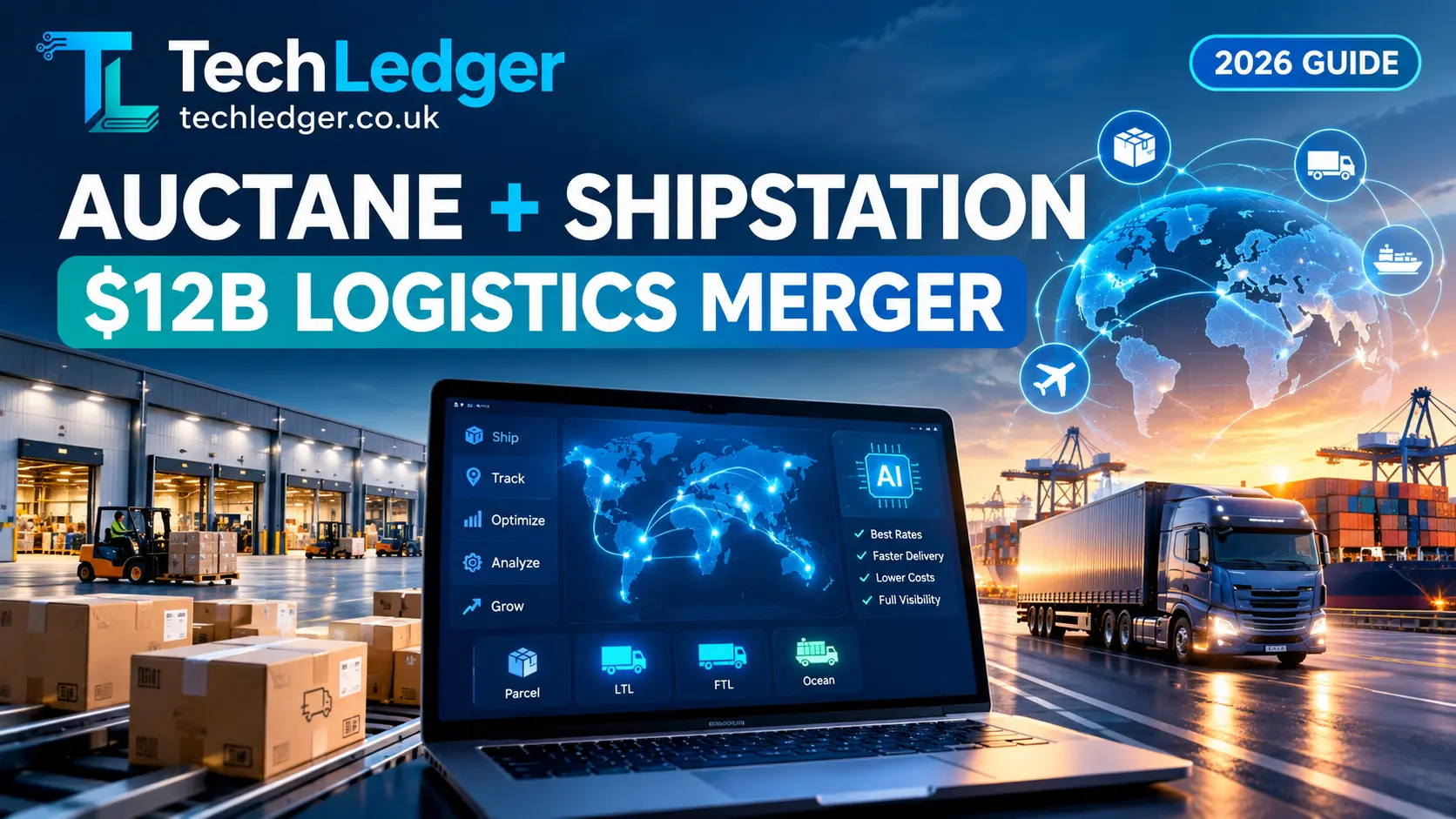
ShipStation Global's unified interface enables merchants to manage parcel and LTL freight shipments from a single dashboard, following the June 2026 Auctane-WWEX merger.
Auctane ShipStation represents the June 2026 merger between Auctane (the shipping software company behind ShipStation, and Metapack) and WWEX Group (a freight brokerage network), creating ShipStation Global a $12 billion logistics platform serving over 3 million customers and processing 3 billion shipments annually. This merger fundamentally transforms how small and mid-sized businesses manage parcel and freight shipping by consolidating everything into a single AI-powered interface. With advanced machine learning algorithms at its core, ShipStation Global streamlines operations by providing real-time insights, predictive analytics, and automated shipping solutions tailored to individual business needs.
This integration allows users to optimize shipping routes, reduce costs, and enhance delivery speed, ultimately improving customer satisfaction and retention rates. Additionally, the platform’s robust API enables seamless connectivity with various e-commerce platforms and marketplaces, empowering businesses to scale effortlessly in an increasingly competitive landscape. As a result, small and mid-sized enterprises can leverage the same shipping efficiencies previously enjoyed only by larger corporations, leveling the playing field in the logistics sector.
What Is Auctane ShipStation? Understanding the Merger That Changed Logistics
The logistics industry witnessed a seismic shift in June 2026 when two major players Auctane and WWEX Group completed a merger that created ShipStation Global. But what does this actually mean for e-commerce businesses, and why should you care? The formation of ShipStation Global signals a transformative era for e-commerce, as it combines the strengths of both companies to enhance shipping solutions, streamline operations, and ultimately lower costs for businesses of all sizes. This merger not only consolidates their technological advancements but also expands their global reach, enabling merchants to tap into new markets with greater ease.
As shipping logistics become increasingly complex, e-commerce businesses must adapt to these changes or risk falling behind competitors who leverage the enhanced capabilities of this new entity. In this evolving landscape, understanding the implications of this merger is crucial for companies looking to optimize their supply chains and improve customer satisfaction.
Auctane was already a dominant force in shipping software, powering brands like ShipStation, Metapack, and Packlink. The company served hundreds of thousands of merchants with tools for order management, label printing, and carrier rate comparison. WWEX Group brought something Auctane lacked: a massive freight brokerage network with over 2,300 sales professionals and relationships with 45,000 truckload carriers.
The result? A unified platform that handles everything from a single parcel to a full truckload shipment all without leaving the same dashboard. Tom Madine, CEO of ShipStation Global, explained the strategic rationale: “Small and mid-sized businesses have been forced to stitch together multiple tools and relationships just to keep up. ShipStation Global changes that. We’re combining the best AI-powered shipping software in the market with one of the country’s most powerful freight networks”.
The combined company operates a portfolio that includes ShipStation, Worldwide Express, GlobalTranz, Metapack, Packlink, Unishippers, JEAR Logistics, and BLX Logistics. It’s headquartered in Texas with offices in Dallas and Austin, and is backed by Thoma Bravo, the world’s largest software-focused investment firm, with CVC Funds retaining a significant minority stake.
The Numbers Behind ShipStation Global
| Metric | Figure |
|---|---|
| Customers Served | 3+ million worldwide |
| Annual Shipments | 3+ billion |
| Global Transactions Processed | $200+ billion |
| LTL Carriers | 75+ |
| Regional, National & International Carriers | 350+ |
| Technology Partners | 600+ |
| Truckload Carriers | 45,000 |
| Company Valuation | ~$12 billion |
| Founded | June 1, 2026 (merger completion) |
Sources: FreightWaves, Worldwide Express press release,
Why This Merger Matters for Small and Mid-Sized Businesses
The Problem Before the Merger
Before June 2026, growing e-commerce businesses faced a frustrating reality. They could handle parcel shipping through ShipStation, but the moment they needed to move inventory between warehouses or ship a pallet of goods, they had to abandon their familiar workflow entirely.
According to ShipStation Global’s CEO, this fragmentation was one of the most common complaints: “One of the most common requests that ShipStation would get in the legacy Auctane world was, ‘When are you going to add other modes to the platform?’ Prior to today, if you were a ShipStation user, you were managing your entire workflow in ShipStation, except when you needed to move freight”.
The data supports this concern. Approximately 78% of ShipStation’s merchants already ship freight in some form, yet more than half were managing it through separate systems. This meant duplicate data entry, reconciliation headaches, and limited visibility across their entire shipping operation.
The Solution After the Merger
ShipStation Global’s first major product integration post-merger was the addition of Less-Than-Truckload (LTL) shipping capabilities. The platform now connects to more than 75 LTL carriers, with over 50 live at launch, giving merchants real-time rate comparison and order management inside the same interface they use for parcel shipping.
Travis Rimel, Chief Product Officer, described the significance: “Freight was the missing piece for ShipStation customers, and now it’s here. This isn’t just a new feature; it’s a foundation”.
The practical impact is substantial. Businesses can now:
- Manage all shipping modes (parcel, LTL, truckload, international) from one dashboard
- Compare real-time rates across carriers without switching platforms
- Track shipments end-to-end with unified visibility
- Reduce manual data entry and associated errors
- Access enterprise-level capabilities previously available only to Fortune 100 companies
ShipStation Pricing: What You’ll Actually Pay in 2026
Understanding the cost structure is essential before committing to any shipping platform. Here’s the current pricing breakdown as listed on the Shopify App Store and ShipStation’s official documentation:
| Plan | Monthly Cost | Users | Key Features |
|---|---|---|---|
| Starter | $14.99 | 3 | Unlimited store connections, automated rate shopping, return labels, basic automations, email support |
| Standard | $29.99 | 10 | Unlimited automations, combine/split orders, bring existing carrier accounts, returns and exchanges, shipping API, phone support |
| Premium | $349.99 | 15 | Inventory management, auto-split, Cubiscan integration, ODBC, dedicated account manager |
Pricing varies based on geography and monthly order volume. All plans include a 30-day free trial.
Is ShipStation Worth the Investment?
The answer depends entirely on your shipping volume and complexity. For businesses shipping hundreds of orders monthly across multiple channels, the automation capabilities alone can justify the cost. One ShipStation customer reported saving 2-3 hours of labor per day during peak season through batch printing alone—equivalent to over 100 labor hours saved during a six-week period.
However, for very small operations shipping fewer than 50 orders monthly, the math may not work in ShipStation’s favor. The platform shines brightest when automation replaces manual processes at scale.
Key Features That Drive Results
Multi-Channel Order Centralization
ShipStation’s core value proposition is eliminating the chaos of multi-channel selling. The platform integrates with over 100 different e-commerce marketplaces and platforms, including Shopify, Amazon, eBay, Walmart, and TikTok Shop. Every order flows into a single dashboard, eliminating the need to jump between platforms and reducing the risk of fulfillment errors.
Automated Rate Shopping
One of the most powerful features for margin protection is automated rate shopping. ShipStation’s automation rules can automatically select the most cost-effective or fastest carrier based on package weight, destination, and service level. This happens in real-time, ensuring you never overpay for shipping simply because you didn’t have time to compare options manually.
Branded Tracking and Customer Experience
The post-purchase experience has become a critical differentiator for e-commerce brands. ShipStation enables merchants to create branded tracking pages and self-service returns portals, giving customers a professional experience that builds loyalty.
According to Josh Steinitz, Chief Strategy Officer, this focus on transparency is essential: “Sometimes offering a slightly faster, slightly more expensive service is actually better because it drives higher conversion”.
Analytics and Reporting
ShipStation provides comprehensive analytics dashboards covering shipments, shipping revenue, costs, and customer engagement metrics. Key metrics include:
- Shipments by carrier and service class
- Shipping revenue vs. cost analysis
- Average cost per label
- Customer engagement (email open rates, click-through rates)
- Sales trends by product and store
This data enables businesses to identify cost-saving opportunities and optimize their carrier mix strategically.
Real-World Results: Customer Success Stories
Norman Love Confections
This Fort Myers, Florida-based artisan chocolate company faced a unique challenge: shipping hand-painted chocolates that could melt if not handled properly, with peak seasons bringing 10,000+ orders in a single day.
The results speak for themselves:
- 15x shipment volume growth (from fewer than 5,000 to over 76,000 annually)
- 2-3 hours of labor saved per day during peak season
- 100+ labor hours saved over a six-week peak
- Label printing time reduced from 3-4 minutes to 10-20 seconds
Toyota Racing Development
TRD ships 9-12 race engines (each weighing 850 pounds) weekly between its Costa Mesa, California build shop and NASCAR teams in North Carolina. A missed delivery isn’t just inconvenient—it’s a public failure.
Working with ShipStation Global, TRD switched from air freight to consolidated ground shipping via straight truck, improving reliability while reducing costs. Kevin Warner of TRD explained: “By going to ground, it allowed us to have much more control, much more reliability on the process and also less handling”.
The Competitive Landscape: How ShipStation Compares
Understanding where ShipStation fits in the broader market helps inform your decision. Here’s how it compares to key alternatives:
| Platform | Best For | Starting Price | Key Strength |
|---|---|---|---|
| ShipStation | High-volume domestic sellers | $14.99/mo | Multi-channel integration, automation depth |
| Shippo | API-first startups | Free tier available | Developer-friendly API |
| Easyship | Cross-border brands | Varies | International shipping (550+ couriers) |
Sources: AfterShip comparison review
ShipStation vs. Shippo
Shippo appeals to developers and startups who want to build shipping functionality directly into their applications. It offers a free tier and strong API documentation. However, ShipStation provides deeper out-of-the-box automation and broader multi-channel integrations, making it better suited for established e-commerce operations.
ShipStation vs. Easyship
For brands focused primarily on international shipping, Easyship offers connections to 550+ couriers and calculates duties and taxes on all plans. ShipStation is stronger for domestic US operations with 200+ carriers but has been investing in cross-border capabilities, including delivery-duties-paid (DDP) features that show full landed costs at checkout.
The Verdict
Choose ShipStation if you’re a domestic-heavy US brand with significant volume that needs robust automation and multi-channel integration. The merger with WWEX Group now adds freight capabilities that no competitor can match, making it uniquely positioned for businesses that ship both parcels and pallets.
Honest Assessment: Where ShipStation Falls Short
No review would be complete without acknowledging the legitimate concerns raised by users. ShipStation’s Shopify App Store reviews reveal a rating of approximately 3.9-4.2 stars, with a notable 19-20% of reviews being 1-star.
Common Complaints
Customer Support Response Times: Multiple reviewers report lengthy wait times for support responses, with some describing 13-24 minute gaps between chat messages. Users on lower-tier plans report being routed to AI chatbots that don’t resolve issues.
Technical Bugs: Some long-term users report persistent issues with login problems, mobile scan sheets not loading, and UI changes that removed previously functional features.
Wallet System Frustrations: The prepaid wallet system for purchasing labels has drawn criticism from users who feel forced to overfund their accounts.
ShipStation’s Response
The company has acknowledged these concerns and continues to invest in support infrastructure. In responses to negative reviews, ShipStation representatives emphasize that unused wallet funds don’t expire and that they’re working on improving system flexibility.
Should Take
The 5-star reviews (69-71% of total) tell a different story—one of businesses that have successfully scaled their operations with ShipStation’s automation. The platform clearly works well when properly configured and when users are on appropriate plan tiers for their volume. The key is going in with realistic expectations and understanding that complex software will occasionally have issues.
The Future of ShipStation Global
The merger between Auctane and WWEX Group isn’t just about combining existing capabilities it’s about building something new. The company’s stated mission is to “close the gap” between what large enterprises can achieve and what small-to-mid-sized businesses can access.
CEO Tom Madine outlined the vision: “What enables customers to have the best experience is that they can use data and intelligence to help them make better decisions. Cheapest is not always bes, it’s about making the best decision so that your supply chain works the way it’s supposed to”.
The AI-enabled platform represents a significant bet that automation and intelligence will become the primary competitive advantages in logistics. With Thoma Bravo’s backing and a $12 billion valuation, ShipStation Global has the resources to continue innovating.
Josh Steinitz, Chief Strategy Officer, emphasized the importance of carrier diversification: “An unbreakable strategy requires a multi-carrier approach integrating giants like UPS and FedEx with regional players and postal services to mitigate risks like strikes, capacity crunches, or price hikes”.
Actionable Recommendations
For Businesses Currently Using ShipStation
- Evaluate your plan tier: If you’re on Starter but need phone support or API access, upgrading to Standard ($29.99/mo) may be worth the investment.
- Explore freight capabilities: If you’re already shipping LTL through separate systems, consolidating into ShipStation could save significant time and reduce errors.
- Leverage analytics: Use the reporting dashboards to identify your most cost-effective carriers and optimize your mix.
For Businesses Considering ShipStation
- Start with the free trial: All plans include a 30-day trial use it to test your specific workflows.
- Calculate your volume: The automation benefits scale with order volume. Below 100 orders/month, the value proposition is weaker.
- Review the integration list: Ensure your sales channels and carriers are supported before committing.
For Businesses Shipping Both Parcels and Freight
The post-merger ShipStation Global is uniquely positioned to serve businesses that need both parcel and LTL capabilities. This was previously a significant gap in the market, and the integrated platform now offers capabilities that neither Auctane nor WWEX could provide independently.
Conclusion: A Platform Transformed
The Auctane ShipStation merger represents more than corporate consolidation it signals a fundamental shift in how logistics platforms serve growing businesses. By combining world-class shipping software with a massive freight network, ShipStation Global has created something that genuinely didn’t exist before: a single platform capable of handling the entire spectrum of shipping needs for small and mid-sized businesses. The $12 billion valuation and the backing of Thoma Bravo suggest significant confidence in this vision. For e-commerce businesses tired of stitching together multiple tools and relationships, the integrated platform offers a compelling alternative.
This innovation not only streamlines operations but also empowers entrepreneurs to focus on growth rather than grappling with logistics complexities. With features like real-time tracking, automated shipping labels, and robust analytics, businesses can enhance their customer experience while reducing costs associated with shipping errors and delays. Moreover, the merger is poised to democratize access to advanced shipping capabilities, enabling smaller players to compete more effectively against larger competitors. As e-commerce continues to evolve, the ability to adapt quickly and efficiently will be paramount, and the Auctane ShipStation alliance is positioned to lead the charge in redefining logistics for the digital age.
That said, no platform is perfect. The customer support concerns raised in user reviews are legitimate, and businesses should approach implementation with realistic expectations. Like any complex software, ShipStation rewards users who invest time in configuration and optimization. For businesses shipping at scale particularly those managing both parcels and freight ShipStation Global deserves serious consideration. The combination of automation, multi-channel integration, and now freight capabilities creates a value proposition that’s difficult to match.
Read Also: PeopleTools ATT: Safe Login Secrets
About the Author