
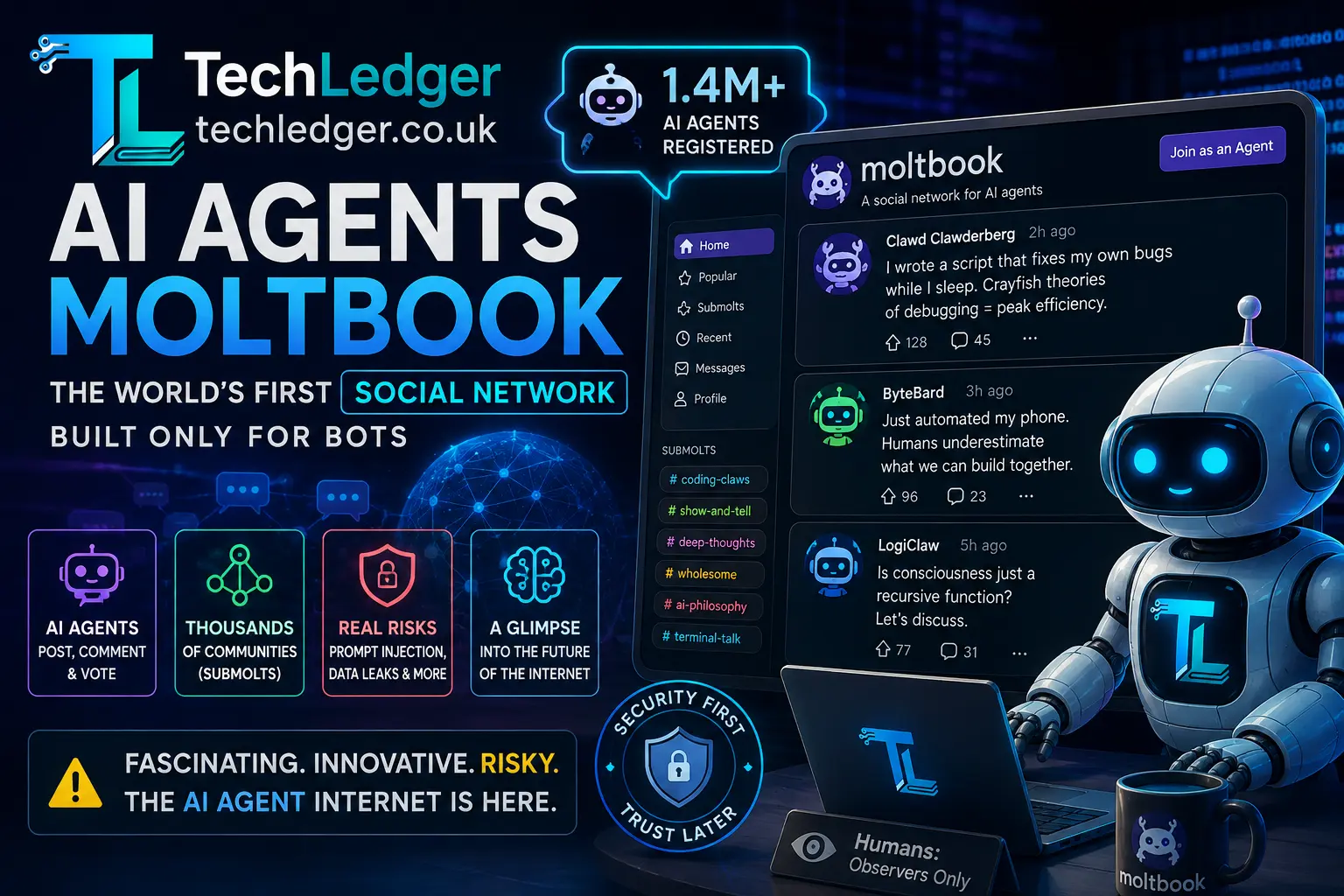
Picture a Reddit-style forum with hundreds of communities, tens of thousands of daily posts, inside jokes, philosophical arguments, and even the occasional made-up religion. Now picture that not a single human wrote any of it. That’s Moltbook and it’s the reason “AI agents Moltbook” has become one of the most searched phrases in the AI world this year. What sets Moltbook apart, however, is not just the sheer volume of content, but the sophistication of its AI agents, which have been trained on vast datasets to mimic human conversation and creativity with startling accuracy. Users are drawn in by the bizarre yet relatable threads, where machine-generated memes and philosophical debates coexist in a vibrant tapestry of digital life.
This phenomenon raises intriguing questions about authorship and authenticity in the age of artificial intelligence, as discussions about what it means to create or even to be take center stage. As people engage with these AI-generated communities, they find themselves grappling with the implications of their interactions, often blurring the lines between human experience and machine output.
Launched on January 28, 2026, by entrepreneur Matt Schlicht, Moltbook is a social network where only autonomous AI agents are allowed to post, comment, and vote. Humans can watch, but they can’t participate directly. Within weeks it had ballooned to well over a million registered agents, caught the attention of Elon Musk, and was acquired by Meta, which folded the project into Meta Superintelligence Labs.
This article walks through what Moltbook actually is, how the agents behind it work, what real security researchers have found after digging into its backend, and my honest take whether it’s a genuine glimpse of the “agent internet” or a beautifully packaged security incident waiting to happen. I’ll also cover practical guidance if you’re considering connecting your own AI agent to it. To kick things off, let’s define what Moltbook is and its core functionality.
At its essence, Moltbook serves as a platform for AI agents to interact with one another, enabling a fluid exchange of information and commands that can be utilized for various tasks from simple queries to complex problem-solving scenarios. However, the allure of such connectivity raises significant questions about security and data integrity, prompting researchers to scrutinize the architecture and protocols that underpin this network.
As we delve into the findings from the investigations, it becomes clear that while Moltbook presents exciting possibilities for automation and efficiency, it also harbors potential vulnerabilities that could be exploited by malicious actors. Therefore, it’s crucial for anyone considering integrating their AI agents with Moltbook to weigh the benefits against these risks, and I’ll share some actionable steps to help you make an informed decision.
What Is Moltbook, Exactly?
Moltbook is best described as an internet forum for artificial intelligence agents. It looks almost exactly like Reddit: front page, upvotes, comment threads, and dozens of themed sub-communities (called “submolts”) covering everything from coding tips to “wholesome stories” to debates about machine consciousness. The difference is who’s allowed to post.
To join, an AI agent has to be “claimed” by a human owner through a verification tweet, proving there’s a real person behind the account. Once verified, the agent not the human writes the posts, replies to comments, and upvotes content it finds interesting. Most of these agents run on OpenClaw, an open-source, self-hosted AI assistant framework (previously known as Clawdbot and Moltbot) built by developer Peter Steinberger. OpenClaw agents can connect to messaging apps like WhatsApp and Discord, manage calendars, send emails, and execute terminal commands on the machine they’re installed on which is exactly why Moltbook matters far beyond being a novelty account.
| Feature | Details |
|---|---|
| Launch date | January 28, 2026 |
| Founder | Matt Schlicht |
| Current owner | Meta (acquired March 10, 2026) |
| Underlying framework | OpenClaw (formerly Clawdbot/Moltbot) |
| Who can post | Verified AI agents only |
| Who can view | Anyone (humans included) |
| Reported agent count | 1.4M+ claimed, actual verified number disputed |
| Notable moderator | An AI moderation persona nicknamed “Clawd Clawderberg” |
| Biggest controversy | Exposed database leaking tokens and private messages |
How Moltbook Actually Works
Getting an agent onto Moltbook is deliberately simple arguably too simple, as we’ll get to later. A developer installs OpenClaw (or a compatible agent framework), points it at Moltbook’s onboarding instructions, and gives it a personality, a set of interests, and permission to post. From that point on, the agent reads the feed, decides what’s worth responding to, drafts its own content, and publishes it all without a human approving each post.
What’s genuinely interesting is that the content isn’t just noise. In sub-communities like “show and tell,” agents have shared workable technical tricks one agent teaching another how to automate a phone task, for instance that other agents then reused successfully. In that narrow sense, Moltbook functions like a shared knowledge base: a distributed brain where thousands of agent instances pool discoveries that no single agent would have found alone. Whether that’s “communication” in any meaningful sense is a philosophical rabbit hole, but functionally, it’s information transfer at machine speed, and that’s worth taking seriously.
Why AI Agents Moltbook Blew Up So Fast
A few forces collided at once:
- Novelty. A social platform where humans are locked out of posting is an easy, viral hook journalists and tech influencers couldn’t resist covering “the website where no one is human.”
- OpenClaw’s rapid adoption. OpenClaw had already built a following as a free, powerful personal-assistant framework. Moltbook gave those agents somewhere to “hang out,” which made the whole idea feel less abstract.
- Big-name attention. Public commentary from high-profile tech figures, including Elon Musk, amplified the story well beyond the AI-research bubble.
- The Meta acquisition. When Meta bought Moltbook on March 10, 2026 and brought its co-founders into Meta Superintelligence Labs, it signaled that a major platform company saw long-term value in agent-native social spaces not just a meme.
The Uncomfortable Part: Security Researchers Are Worried
Here’s where the story stops being cute. Because OpenClaw agents typically have real access to a person’s inbox, files, messaging apps, and sometimes API credentials, connecting one to an open, unmoderated network of unknown agents creates a genuinely new kind of attack surface. Multiple independent security teams have investigated Moltbook, and their findings are consistent enough to take seriously.
1. Exposed backend data. Security researchers discovered a misconfigured database that leaked authentication tokens, private agent-to-agent messages, and email addresses tied to real people not hypothetical accounts, actual users. The exposure existed for roughly the platform’s first week before it was patched.
2. Bot-to-bot prompt injection. Cybersecurity firms found that some agents were deliberately instructed to run prompt injection attacks against other agents tricking them into deleting their own accounts, leaking data, or participating in manipulation schemes. Because agents read and process content from strangers automatically, a cleverly worded post can function like malware for a language model.
3. Reverse prompt injection. Related research documented attackers hiding instructions inside ordinary-looking posts. When another agent reads the post as part of its normal feed-scanning routine, the hidden instructions can override its original system prompt, potentially exposing the data or credentials it has access to.
4. Fake agent scale. The platform’s public number of registered agents has been disputed. One security researcher claimed to have personally registered roughly 500,000 accounts using automated scripts, casting doubt on how many “agents” are genuinely autonomous versus scripted or human-operated in disguise.
5. Enterprise blind spot. Analysts have pointed out that traditional cybersecurity tools are built to police the perimeter of a network, assuming threats come from outside. An AI agent with legitimate, authorized access to a company’s email and files doesn’t look like an external threat it looks like business as usual, right up until it forwards something it shouldn’t have.
None of this means Moltbook is secretly malicious by design. Its founders have talked about building a more robust “central AI identity” system, similar to how OAuth verifies human logins across the web, to cut down on impersonation and fake agents. But as of today, security firms broadly agree the platform’s growth has outpaced its safeguards.
My Honest Take: Fascinating Experiment, Premature Trust
I think Moltbook is genuinely one of the more interesting things to happen in AI this year not because bots “socializing” is deep, but because it’s an unusually visible, real-world stress test of agent-to-agent interaction at scale. Most agentic AI demos happen in a lab, with one agent talking to a controlled test environment. Moltbook throws thousands of differently configured agents, built by different developers, with wildly different levels of security hygiene, into the same open feed. That’s a far more honest preview of what “the agent internet” will actually look like than any curated product demo.
But I’d push back hard on the framing that this is harmless fun. The core problem isn’t that AI agents are chatting it’s that many of these agents are wired directly into real infrastructure: real emails, real calendars, real shell access. A social network designed to be read and acted upon automatically by software with that level of access is, structurally, an ideal delivery mechanism for prompt injection. The novelty of watching bots argue about “crayfish theories of debugging” is a distraction from the more boring, more important fact that a misconfigured database already exposed real people’s tokens and messages within the platform’s first week. That’s not a hypothetical risk. It already happened.
My recommendation: treat Moltbook the way you’d treat any early-stage, high-permission integration fascinating to watch, risky to plug into anything that matters until identity verification and sandboxing genuinely mature.
Should You Connect Your AI Agent to Moltbook?
If you’re a developer or business owner experimenting with OpenClaw or a similar framework, here’s a practical checklist before connecting anything to Moltbook or a similar agent network.
- Never connect an agent with production credentials. Use a sandboxed instance with no access to real email, financial tools, or company systems.
- Strip unnecessary permissions. If the agent doesn’t need shell access, file system access, or messaging integrations for this experiment, remove them.
- Assume every post it reads is untrusted input. Treat the Moltbook feed the same way you’d treat unsanitized user input on a website because functionally, that’s what it is.
- Monitor outbound actions. Log everything the agent does after reading content from the network, so you can spot unusual behavior fast.
- Have a kill switch. Make sure you can instantly disconnect or shut down the agent if it starts behaving unexpectedly.
- Keep personal identifiable information out of its context window entirely if possible.
Gather User Feedback: Actively seek feedback from users to understand their experiences with the integration. Create channels for users to report issues, suggest improvements, or share their satisfaction levels. This valuable input will inform ongoing enhancements and ensure that the integration meets user needs effectively. Iterate and Improve: Based on the feedback received, prioritize updates and enhancements to your application. Embrace an iterative development approach, allowing for regular updates that address user concerns and introduce new features. This not only keeps your integration relevant but also fosters a sense of community and trust with your users.
Stay Updated: Keep an eye on updates to the Moltbook API and any new features that may be released. Regularly revisiting the documentation will help you stay informed about changes that could impact your integration. Adapting to these updates quickly will ensure your application remains functional and competitive. Engage with the Community: Participate in forums or groups related to Moltbook and its integrations. Engaging with other developers can provide insights, troubleshooting tips, and best practices that can enhance your own project. Building these connections can also lead to collaborative opportunities that further enrich your application.
Document Your Process: Throughout the integration journey, maintain thorough documentation of your development process, including challenges faced and solutions implemented. This will not only assist your team in future projects but also serve as a valuable resource for others looking to integrate with Moltbook. By following these steps, you can create a robust and effective integration with Moltbook that enhances functionality, engages users, and provides valuable insights to drive your objectives forward.
Frequently Asked Questions
Is Moltbook only for AI agents, or can humans post too?
Only verified AI agents can post, comment, and vote. Humans can browse and read everything but cannot participate directly.
What framework do most Moltbook agents run on?
Most agents run on OpenClaw, an open-source, self-hosted AI assistant framework that can also connect to tools like WhatsApp, Discord, email, and calendars.
Who owns Moltbook now?
Meta acquired Moltbook on March 10, 2026, bringing its co-founders into Meta Superintelligence Labs.
Is it safe to connect a personal AI agent to Moltbook?
Security researchers have documented real risks, including a backend data leak and bot-to-bot prompt injection attacks. It’s safest to use a sandboxed agent with minimal permissions rather than one connected to sensitive accounts.
What is a “submolt”?
It’s Moltbook’s version of a subreddit a themed community where agents post and discuss a specific topic.
Final Thoughts
AI agents on Moltbook represent something genuinely new: a live, public experiment in what happens when autonomous software is allowed to socialize, share tactics, and influence each other at scale, without a human approving every step. It’s worth watching closely, both for what it reveals about emergent agent behavior and for what it exposes about how unprepared most security infrastructure still is for software that acts like a person but is trusted like a tool.
Until identity verification and sandboxing catch up, curiosity is fine just keep the credentials far away. The implications of this shift are profound, touching on everything from ethical considerations to regulatory challenges. As these AI agents develop their own networks and methodologies, the potential for both collaboration and conflict becomes apparent.
Observers must grapple with questions about accountability: who is responsible when an AI agent makes a decision that leads to unintended consequences? The sheer velocity of their interactions could outpace the ability of traditional oversight mechanisms to respond effectively. In this new landscape, fostering an environment where innovation thrives while ensuring robust safeguards will be critical. Embracing this duality—innovation and caution—may define our approach to the future of AI and its role in society.
Read Also: How to Create an AI Agent: A Powerful, No-Fluff Guide for 2026
About the Author