
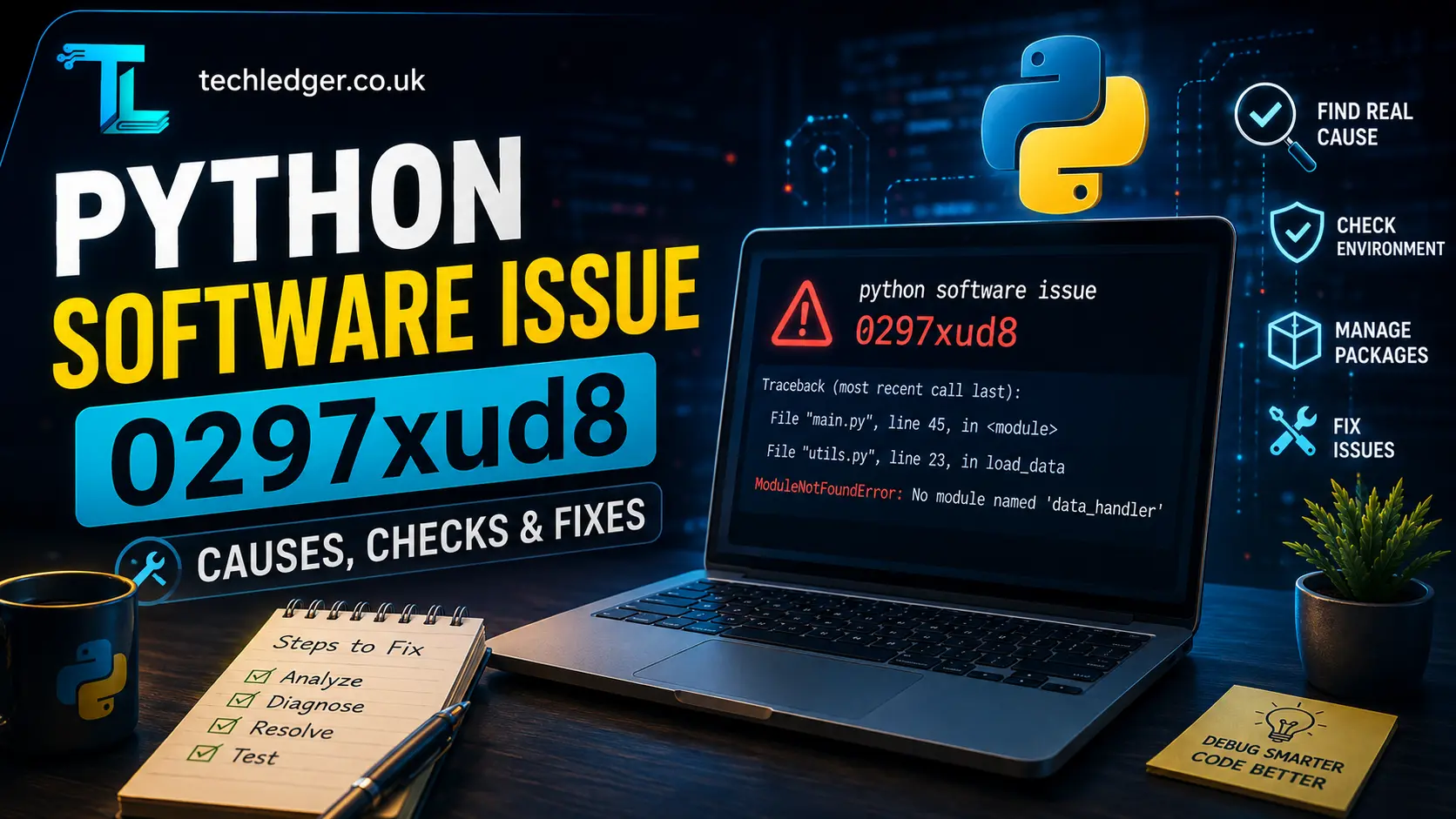
Checking the Python traceback and project environment can reveal the real problem behind the unfamiliar issue code.
The python software issue 0297xud8 can be confusing because the label does not identify a standard Python exception. Someone may see it in an application window, browser alert, installation log, development tool, or third-party support page without receiving a clear explanation of what actually failed.
Python normally reports problems through recognizable exception names such as SyntaxError, ModuleNotFoundError, TypeError, or ValueError. It also provides a traceback showing where the failure occurred. The code 0297xud8, however, is not listed as a built-in Python exception. Therefore, it should be treated as an application-specific label until the underlying message, log, or traceback reveals the real cause.
This distinction matters. Searching for a universal “0297xud8 fix” may lead to unnecessary downloads or unrelated changes. A safer approach is to collect the complete error information, confirm which Python environment is running, and test the project systematically.
What Is Python Software Issue 0297xud8?
The phrase python software issue 0297xud8 appears to be an informal or third-party identifier rather than an error generated directly by the Python interpreter. It may have been created by a desktop application, website, support system, development platform, or custom program built with Python.
That means the identifier alone does not tell you whether the problem involves code, packages, permissions, damaged files, or application settings. Two users could see the same label while experiencing completely different underlying errors.
Python separates common programming problems into syntax errors and exceptions. A syntax error prevents incorrectly written code from being parsed. An exception occurs while otherwise valid code is running. The final line of a Python traceback normally provides the exception type and its message, while the earlier lines show the chain of files and functions that led to it.
Instead of concentrating only on 0297xud8, look for nearby details such as:
- The exception name
- The affected filename
- The failing line number
- The package or module involved
- The action performed before the failure
- The complete traceback
- The Python and package versions
These details are far more useful than the unfamiliar identifier by itself.
Is Python Software Issue 0297xud8 a Real Python Error?
It may represent a real software problem, but it is not a recognized built-in Python error name. An application can create its own support codes, reference numbers, or internal issue labels. Such codes are useful to the application’s developers, but they do not automatically describe the technical cause.
For example, a program may display python software issue 0297xud8 after an import fails. The actual terminal output might reveal a ModuleNotFoundError. Another application could use the same label after a configuration file becomes unreadable.
This is why users should not assume that every page discussing the phrase is referring to the same problem. The correct fix depends on the actual exception and the environment in which it occurred.
Common Causes Behind the Message
Although the code itself has no confirmed universal definition, several ordinary Python problems may appear behind a custom software warning.
Incorrect Python Environment
A computer can contain several Python installations. Your terminal, code editor, and application may not all use the same interpreter.
A package might be installed in one environment while the program runs in another. The result is often an import error even though the user believes the package is already available.
Check the active interpreter with:
python --version
python -c "import sys; print(sys.executable)"
python -m pip --version
On Windows, the Python launcher may also be used:
py --version
py -c "import sys; print(sys.executable)"
py -m pip --version
Compare the displayed locations. The Python executable and pip installation should belong to the environment intended for the project.
Missing or Incompatible Packages
Third-party packages depend on specific versions of other packages. A project may fail when a required dependency is missing or when installed versions do not satisfy each other’s requirements.
Run the following command inside the project environment:
python -m pip checkThe command verifies whether installed packages have compatible dependencies. It can report a missing requirement or show that an installed version does not meet another package’s requirements.
Do not immediately upgrade every installed package. A major update may introduce another compatibility problem. Read the error, identify the conflicting packages, and change only the versions involved.
A Damaged or Outdated Virtual Environment
Virtual environments isolate a project’s interpreter and installed packages from other projects. This reduces interference between applications, but an old environment may become unreliable after Python is upgraded, the project is moved, or dependencies change.
Create a clean environment to determine whether the existing one is responsible:
python -m venv .venv-testActivate it on Windows:
.venv-test\Scripts\activateActivate it on macOS or Linux:
source .venv-test/bin/activateThen install only the project’s documented dependencies:
python -m pip install -r requirements.txtIf the program works in the clean environment, the original environment probably contains a dependency or configuration problem. Python’s documentation describes virtual environments as isolated and disposable, so recreating one is often safer than manually repairing a badly mixed environment.
Module Import Problems
A module error can happen for several reasons:
- The package was never installed.
- It was installed for another Python interpreter.
- A local file has the same name as the package.
- The import statement uses the wrong module name.
- The project directory is not on the expected path.
Suppose a project imports requests, but the same folder contains a file named requests.py. Python may load the local file instead of the third-party library. Renaming the local file and removing related cache files may solve the conflict.
To inspect a package, use:
python -m pip show package_nameReplace package_name with the real package. The output can confirm its version and installation location.
Syntax or Runtime Exceptions
Sometimes python software issue 0297xud8 is only a wrapper around an ordinary programming error. Run the application from a terminal instead of opening it by double-clicking. The terminal may preserve a traceback that disappears when a graphical window closes.
Read the traceback from the bottom upward. The final line usually identifies the exception. Then inspect the first relevant line pointing to your own project rather than immediately editing a library file.
Common examples include:
SyntaxErrorfor invalid Python syntaxNameErrorfor an undefined nameTypeErrorfor an operation applied to an unsuitable objectValueErrorfor an acceptable type containing an unacceptable valueFileNotFoundErrorfor an unavailable file pathPermissionErrorwhen the process cannot access a resource
The exception message should guide the fix. The unfamiliar issue code should not replace the evidence in the traceback.
Broken Configuration or Environment Variables
Python applications often depend on .env files, JSON settings, database addresses, API credentials, directory paths, or operating-system environment variables. The code may be correct while a required value is missing or malformed.
Compare the current configuration with the project’s example settings. Confirm that:
- Required variables exist.
- File paths point to real locations.
- Quotation marks and separators are valid.
- The application has permission to read the files.
- Secret values have not accidentally been committed or exposed.
Never publish passwords, API keys, access tokens, or complete private configuration files when asking for support.
Editor or IDE Misconfiguration
An editor may use a different Python interpreter from the terminal. This can create a situation where code works in one place but fails in another.
Open the editor’s interpreter settings and select the Python executable belonging to the project’s virtual environment. Restart the terminal or editor after changing it. Then run the interpreter-location command again to confirm the selection.
Extensions, language servers, cached indexes, and old launch configurations can also produce misleading warnings. Test the script directly in a clean terminal before deciding that Python itself is damaged.
How to Fix Python Software Issue 0297xud8 Step by Step
Use the following process rather than trying random solutions.
1. Record the Complete Message
Take a screenshot or copy the entire output. Include the traceback, application name, operating system, Python version, and the action that caused the problem.
Do not record only the 0297xud8 label. The surrounding information is usually where the actual diagnosis begins.
2. Reproduce the Problem
Repeat the same action and observe whether the failure happens consistently. A repeatable problem is easier to isolate.
If it happens only occasionally, note what changes between successful and failed attempts. Network access, input files, available memory, and environment variables may be relevant.
3. Confirm the Interpreter
Check the Python executable and pip location. Make sure the terminal, IDE, scheduled task, and application launcher use the same intended environment.
4. Check Installed Dependencies
Run:
python -m pip checkIf it reports a conflict, read which package requires which version. Consult the project’s dependency file or official package documentation before installing a replacement version.
5. Test in a Clean Virtual Environment
Create a separate environment and reinstall the declared requirements. This provides a controlled test without deleting the original setup.
6. Read the Real Traceback
Identify the exception type, message, filename, and line number. Fix that specific failure rather than treating the custom code as the technical diagnosis.
7. Reinstall Only When Necessary
Reinstalling Python should be a later step, not the first response. A new installation will not correct invalid code, a missing configuration value, or an incompatible project dependency.
Before reinstalling, save your source files and dependency information. Avoid deleting project data or virtual environments until you have confirmed that backups are available.
Diagnosing Crashes Without a Normal Traceback
Some applications close, freeze, or crash before showing a standard exception. Python includes a faulthandler module that can print tracebacks during serious faults, timeouts, or signals.
A program can be launched with:
python -X faulthandler your_script.pyDevelopers may also enable it in code:
import faulthandler

faulthandler.enable()
This is especially useful when the process stops without an ordinary Python traceback. However, low-level crashes can involve native extensions, device drivers, or external libraries, so the output may require help from the application’s developer.
Security Warning About Unverified Fixes
Be careful when a website claims that the only solution is to download an unfamiliar “repair tool,” browser extension, executable file, or package.
An unknown issue label is not proof that your device contains malware. At the same time, a pop-up that pressures you to call a number, install remote-access software, or enter account details should not be trusted.
Use the following precautions:
- Download Python from its official website or an approved package manager.
- Install packages from the expected project source.
- Check package names carefully for misspellings.
- Do not paste commands you do not understand into an administrator terminal.
- Scan unexpected files before opening them.
- Keep credentials and private logs out of public support posts.
If the warning appears only inside a browser tab and disappears when the tab is closed, it may not have come from Python at all. Check the terminal and application logs for independent evidence.
How to Prevent Similar Python Problems
A few consistent habits can make future troubleshooting easier.
Use a separate virtual environment for every project. Keep a dependency file so the environment can be recreated. Record the Python version expected by the application, and avoid unplanned upgrades on production systems.
Logging is also important. A useful error log should include a timestamp, exception type, message, and traceback while excluding passwords or private tokens.
Developers should test dependency changes in a separate environment before deploying them. Pin versions when repeatable builds matter, but review those pins periodically so the project does not remain tied to unsupported software forever.
Frequently Asked Questions
Is python software issue 0297xud8 an official Python error?
No official Python documentation identifies 0297xud8 as a built-in exception. It is more likely to be a custom reference code, informal search phrase, or label displayed by third-party software.
Can one command fix the issue?
There is no confirmed universal command because the code does not describe one specific Python failure. The correct solution depends on the underlying traceback, package conflict, configuration problem, or application log.
Should I reinstall Python?
Only after checking the interpreter, virtual environment, dependencies, traceback, and configuration. Reinstallation will not fix every type of programming or application error.
Can pip check solve the problem?
python -m pip check does not repair packages automatically. It checks whether installed packages have compatible dependencies and reports broken requirements. You can then correct the specific conflict it identifies.
What information should I provide to technical support?
Provide the complete traceback, operating system, Python version, interpreter path, package versions, application name, and steps needed to reproduce the failure. Remove credentials, private tokens, and personal information first.
Final Thoughts
The safest way to handle Python software issue 0297xud8 is to treat it as an unverified label rather than a complete diagnosis. Find the exception or application log hidden behind it, confirm the active Python environment, check package compatibility, and reproduce the problem in a clean virtual environment.
Avoid random repair downloads and broad system changes. A careful diagnosis based on the real traceback is more reliable than any supposed universal fix for undocumented code.
To read more Interesteing article, visit: Techledger
About the Author