
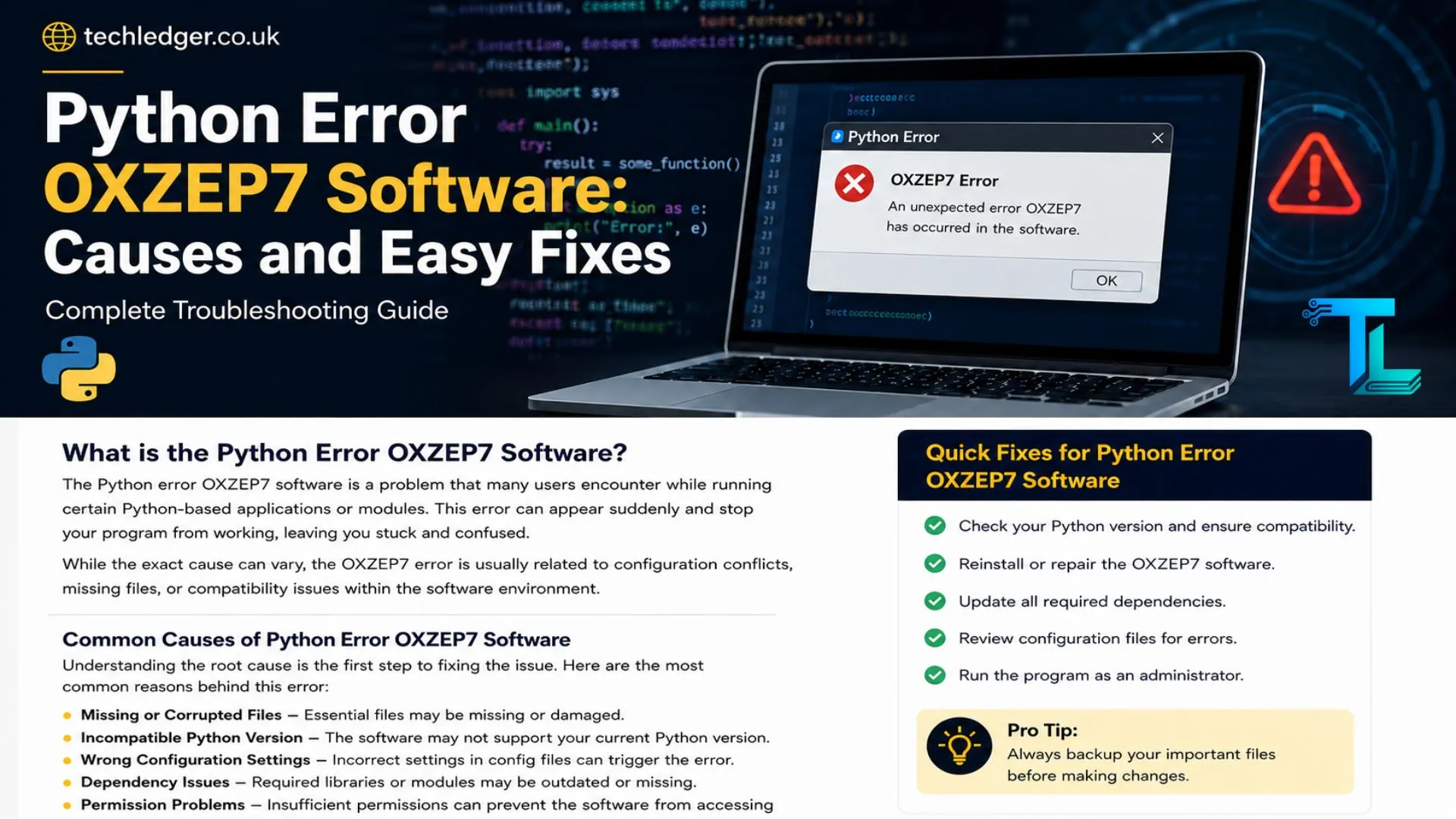
A developer checks a Python traceback, dependencies, and virtual environment to identify an Oxzep7-related software error.
Searching for a solution to the Python error oxzep7 software problem can be confusing. Many pages mention the phrase, but they do not always show an authentic error message, an official download page, or verified technical documentation.
That distinction matters. “Oxzep7” does not appear to be the name of a standard Python exception. Python normally reports recognizable exceptions such as ModuleNotFoundError, ImportError, SyntaxError, TypeError, or PermissionError. These names appear at the end of a traceback and help identify what actually went wrong.
At the time of checking, there was also no clearly established official documentation or widely recognized package record confirming Oxzep7 as a standard Python tool. Some websites describe it as software, a development framework, or an error code, while other sources point out the lack of verifiable documentation.
For that reason, the safest approach is not to guess what Oxzep7 does. Instead, identify the real Python exception, confirm where the software came from, and troubleshoot the environment systematically.
What Does Python Error Oxzep7 Software Mean?
The phrase Python error oxzep7 software may refer to several different situations:
- A local or privately developed Python application named Oxzep7
- A third-party script distributed outside the Python Package Index
- A misspelled package or module name
- A custom error label created by an application
- A damaged or incomplete Python installation
- A dependency, environment, or configuration problem
- An unverified search phrase that does not identify one specific error
Python itself does not usually display vague phrases without additional details. A genuine Python failure normally includes a traceback showing the files, line numbers, function calls, exception type, and final error message.
For example, the useful part of an error may look like this:
ModuleNotFoundError: No module named 'oxzep7'It could also appear as:
ImportError: cannot import name 'example' from 'oxzep7'These two errors require different fixes. The first suggests that Python cannot locate the module. The second suggests that the module may exist, but the requested object is missing, renamed, or unavailable in the installed version.
The full traceback is therefore more valuable than the phrase “Oxzep7 error” alone.
Read the Complete Python Traceback First
Before updating, uninstalling, or downloading anything, copy the complete error message. Do not focus only on the first line.
Python’s documentation explains that the final line of a traceback identifies the exception type and usually describes what happened. The earlier lines show the sequence of files and function calls that led to the failure.
Look for these details:
- The exception name
- The final error message
- The file in which the problem occurred
- The affected line number
- The package or module being imported
- The command that produced the error
- The Python version in use
A screenshot may be useful for reference, but plain text is better when searching documentation or sharing the problem with a developer.
Verify That Oxzep7 Is a Real and Trusted Package
If the error appeared after you downloaded a file, plugin, or program, verify its source before running more commands.
Python packages are commonly distributed through the Python Package Index, while pip is the standard installer used to retrieve packages from PyPI and other configured indexes.
Run the following command to see whether a package with that name is installed:
python -m pip show oxzep7Windows users who normally use the Python launcher can run:
py -m pip show oxzep7If pip reports that the package cannot be found, it may mean:
- The package was never installed
- Its distribution name is different from its import name
- It was installed in another Python environment
- It is private software rather than a public package
- The name has been misspelled
- The software is not a genuine Python package
Do not download an unfamiliar executable or archive simply because its filename contains “Oxzep7.” Look for an identifiable developer, an official repository, installation instructions, version history, licensing information, and a way to report security problems.
Check Which Python Installation Is Running
One of the most common causes of package errors is using one Python installation to install a library and another installation to run the program.
On Windows, check the active versions with:
py --version
py -m pip --version
py -c "import sys; print(sys.executable)"
On macOS or Linux, use:
python3 --version
python3 -m pip --version
python3 -c "import sys; print(sys.executable)"
The pip output should point to the same Python installation that runs your program. Official pip guidance recommends checking both Python and pip before attempting package-related repairs.
Using python -m pip or py -m pip is generally clearer than running pip by itself because it connects the installation command to a specific Python interpreter.
Create a Clean Virtual Environment
A virtual environment separates one project’s packages from the rest of the computer. This prevents unrelated projects from overwriting or conflicting with one another’s dependencies.
Python’s venv module creates an isolated environment with its own interpreter and installed packages. The environment can be deleted and recreated without removing the project’s source files.
Create an environment inside the project directory:
python -m venv .venvOn Windows Command Prompt, activate it with:
.venv\Scripts\activateOn Windows PowerShell, use:
.venv\Scripts\Activate.ps1On macOS or Linux, use:
source .venv/bin/activateAfter activation, update pip:
python -m pip install --upgrade pipThen install the project’s dependencies from its official requirements file:
python -m pip install -r requirements.txtOnly run the final command when the requirements.txt file came from a source you trust.
Check for Missing or Conflicting Dependencies
A Python program may start successfully but fail when it reaches a feature that depends on another package. It may also break when two installed libraries require incompatible versions of the same dependency.
Use this command inside the correct environment:
python -m pip checkThe pip check command verifies whether installed packages have compatible dependencies. It can identify missing requirements or packages whose installed versions do not satisfy another package’s requirements.
You can also inspect the installed packages:
python -m pip listTo save the exact environment for comparison or restoration, run:
python -m pip freeze > requirements-current.txtDo not immediately upgrade every package to its newest release. A project may rely on a specific version, and an uncontrolled upgrade can create additional compatibility problems.
Fix a ModuleNotFoundError
Suppose the traceback contains:
ModuleNotFoundError: No module named 'oxzep7'First, confirm that the name is spelled correctly. Package distribution names and Python import names are not always identical.
Next, check whether the expected package exists in the active environment:
python -m pip listIf the package belongs to a local project rather than PyPI, check whether you are running the command from the correct project directory.
You can also display Python’s module search paths:
python -c "import sys; print('\n'.join(sys.path))"For a local module, confirm that:
- The file or package directory exists
- The filename matches the import statement
- The project directory is included in Python’s search path
- Another file does not have the same name as a standard library or dependency
- The program is being launched from the intended directory
Avoid permanently changing system environment variables until you understand why Python cannot locate the module.
Fix ImportError or AttributeError Messages
An ImportError may occur when a package is installed but does not contain the object requested by the code.
For example:
ImportError: cannot import name 'start' from 'oxzep7'Possible explanations include:
- The function was renamed
- The installed package version is too old or too new
- The documentation belongs to a different release
- A local file is hiding the real package
- The installation is incomplete
- A circular import exists within the project
Inspect the installed package information with:
python -m pip show oxzep7When the module can be imported, this command may reveal the file Python is loading:
python -c "import oxzep7; print(oxzep7.__file__)"Replace oxzep7 with the actual module name shown in the traceback. If the displayed path points to an unexpected project file, rename that file and remove any related __pycache__ directory before testing again.
Reinstall Only After Recording the Current Setup
Reinstallation can repair missing files, but it should not be the first troubleshooting step. Before removing anything, record the current version and configuration.
For a verified package, a controlled reinstall may look like:
python -m pip uninstall package-name
python -m pip install package-name
Use the real, verified package name rather than assuming it is oxzep7.
When a project provides an exact version requirement, install that version:
python -m pip install package-name==1.2.3Version pinning can make an environment reproducible, but the version should come from official project documentation or a trusted requirements file.
Check Configuration Files and Environment Variables
Some applications depend on API keys, database addresses, file paths, ports, or other settings stored outside the Python code.
A missing setting may produce errors such as:
KeyError: 'API_KEY'or:
FileNotFoundError: configuration file not foundCheck the project documentation for files such as:
.env
config.json
settings.yaml
pyproject.toml
requirements.txt
Never publish passwords, private keys, access tokens, or complete .env files when requesting help. Remove sensitive values from screenshots and error reports.
Avoid Unsafe “One-Click” Fixes
Search results for unfamiliar error phrases sometimes recommend downloading a repair tool, disabling antivirus protection, editing the registry, or running unknown commands with administrator privileges.
Those actions are rarely appropriate for an ordinary Python exception.
Avoid:
- Downloading an unofficial “Oxzep7 fixer”
- Running scripts you have not inspected
- Disabling security software
- Sharing secret keys in public forums
- Installing random packages with similar names
- Running every command as administrator
- Deleting system Python folders manually
- Copying files directly into
site-packages
A clean virtual environment is generally safer than modifying a system-wide Python installation.
Prevent Python Error Oxzep7 Software Problems
Once the application works, document the repair so the same issue does not return.
Record:
- The working Python version
- The operating system
- The exact package versions
- The installation source
- Required environment variables
- The command used to start the application
- Any external tools or system libraries it needs
Keep each project in a separate virtual environment and store dependencies in a version-controlled requirements or project configuration file. Do not place the virtual environment itself in source control; Python’s documentation describes these environments as disposable and intended to be recreated.
Adding logging can also make future failures easier to diagnose. Python’s logging tools can record errors and exceptions with useful runtime context instead of leaving users with a vague failure message.
Frequently Asked Questions
Is Python error oxzep7 software an official Python error?
It does not appear to be a documented built-in Python exception. The real problem should be identified from the final line of the traceback, such as ModuleNotFoundError, ImportError, or PermissionError.
Is Oxzep7 available on PyPI?
No clearly verified public package record was established during the research for this guide. Confirm the exact package name and obtain installation details from the software’s genuine developer.
Can updating Python fix the error?
Sometimes, but not always. Updating Python can also break older packages. Check the project’s supported Python versions before changing the interpreter.
Should I reinstall Python?
Reinstallation is usually unnecessary until you have checked the traceback, interpreter path, pip location, virtual environment, and dependencies. A clean virtual environment often provides a safer test.
Why is the package installed but Python cannot import it?
The package may have been installed into a different interpreter or virtual environment. Compare the output of python --version, python -m pip --version, and python -c "import sys; print(sys.executable)".
Is it safe to download Oxzep7 software?
Treat it as unverified unless you can identify an authentic developer, official documentation, a trusted distribution channel, and transparent installation files. Do not rely on a download page solely because it uses the same keyword.
Conclusion
The phrase Python error oxzep7 software does not provide enough technical information to identify a single problem. It may describe a private application, an incorrect package name, a local project, or an unverified term circulating across websites.
The reliable solution is to find the real exception in the traceback, verify the software’s source, confirm that Python and pip use the same interpreter, create a clean virtual environment, and inspect dependency compatibility. These steps address genuine Python problems without relying on risky downloads or invented technical claims.
Visit: Techledger
About the Author